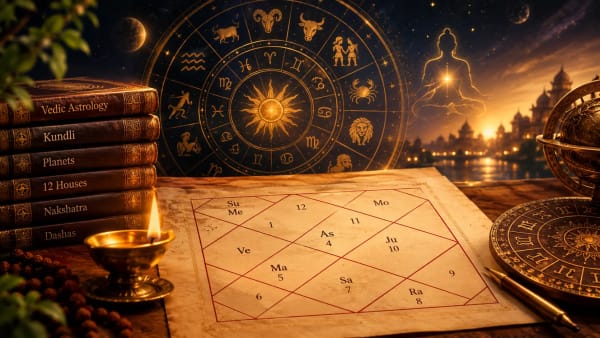
Maybe you've seen people talk about their 'sun sign', 'moon sign' and 'rising sign' and wondered which one really describes them. The short answer is: all three, but each in a different layer of your life. In Vedic astrology, your sun sign points to your core self, your moon sign describes your inner emotional nature, and your rising sign (Lagna / Ascendant) shapes how you appear to others. Together, they are the most practical starting point for reading a Kundli.
Before we go deeper, one honest distinction matters. Jyotish, or Vedic astrology, is a traditional system of interpretation and spiritual guidance, not a scientifically proven method for predicting events. You can use it for self-reflection and better self-understanding, but it works best when approached with curiosity rather than blind certainty.
What Are Sun, Moon and Rising Signs Exactly?
In Vedic astrology, the zodiac is divided into 12 signs (Rashis), each covering 30 degrees of the sky. The Sun and the Moon are both called grahas (planets) in Jyotish, and their positions at the moment of your birth give you your sun sign and your moon sign. Your rising sign, however, is not based on a planet. It is the sign that was rising on the eastern horizon at your birthplace when you were born. In Sanskrit, this is known as Lagna, and in English, it is the Ascendant.
So there are not three different zodiacs. There is one zodiac, and the sun, moon, and rising signs are three different positions or points within it, each carrying a distinct meaning.
Sun Sign Meaning in Vedic Astrology
In Jyotish, the Sun (Surya) represents the soul, life force, ego, confidence, father, and authority. Your sun sign, therefore, is about who you are becoming, not just what you were born as. It reveals your basic sense of purpose, the way you assert yourself, and the areas where you are meant to grow in confidence. The Sun changes signs roughly once a month, which is why it is the easiest placement to determine and the most common sign people know.
That said, a sign alone is only one layer. In a full Kundli, the Sun also has a specific degree, a Nakshatra, and a house position. Astrologers look at these details rather than relying on a single label. And because Vedic astrology uses the sidereal zodiac, your Vedic sun sign may differ from the Western sun sign you are used to reading. Neither is 'wrong'; they are based on different astronomical reference points.
Moon Sign Meaning in Vedic Astrology
The Moon (Chandra) represents the mind, emotions, instincts, memory, mother, and emotional security. Your moon sign shows how you feel before you think. It also describes what makes you feel safe, how you care for others, and the inner habits that repeat when you are tired or stressed. In Vedic astrology, the moon sign is often given more emotional weight than the sun sign because the mind rules so much of daily experience. Many astrologers use the moon sign, also called Janma Rashi, as their main reference sign.
The Moon stays in each sign for only about two and a quarter days, which is why an accurate birth time and place matter. Your moon sign also determines your Nakshatra, the birth star used for deeper personality analysis and for calculating the Vimshottari Dasha planetary periods. For a deeper introduction, visit What Is a Moon Sign? Meaning in Vedic Astrology.
Rising Sign Meaning and the Ascendant
Your rising sign, or Lagna, is the sign that was coming over the eastern horizon at the time of your birth. Because the Earth turns, a different sign rises approximately every two hours. That is why two people born in the same place but a few hours apart often have different rising signs, even if their sun and moon signs are identical.
The rising sign sets the entire house system of a Kundli. The sign on the horizon becomes the first house, and the following signs move through the second house, third house, and so on. For this reason, Lagna is considered a deeply personal anchor in Vedic astrology. It influences your appearance, temperament, natural reactions, and the first impression you make. It also determines where the Sun and Moon fall in your houses, which can completely change the chart's interpretation. If you want a dedicated explanation, our article on What Is a Rising Sign? Ascendant Meaning Explained covers this in more detail.
How Sun, Moon and Rising Signs Work Together
The sun, moon, and rising signs are not competing versions of you. They are different layers working together. Think of it this way: your sun sign is the story you are learning to live; your moon sign is the emotional soundtrack behind that story; and your rising sign is the cover page others see first.
For example, someone with a Leo sun, Cancer moon, and Virgo rising may appear neat, reserved, and practical when you first meet them, because Virgo rising tends to show up that way. Under the surface, their Leo sun wants to be seen and appreciated, while their Cancer moon craves comfort and close emotional bonds. None of these traits cancels another out; together they make a full person.
In a complete reading, an astrologer also considers planetary aspects, house placements, Nakshatras, and Dasha periods. But the sun, moon, and rising signs give you a clear and friendly place to begin.
Why People Call These the 'Big Three'
In modern astrology, you will sometimes hear these three placements called the 'Big Three.' This phrase is not traditional Vedic terminology, but it is a convenient way to remind beginners that a person is more than their sun sign. The sun sign answers 'who am I at heart?', the moon sign answers 'what do I need emotionally?', and the rising sign answers 'how do I appear to others?' Keeping those three questions in mind can make any birth chart feel more approachable.
Sun, Moon and Rising Signs: a Quick Comparison
| Sign | What it represents | How it is calculated | Approximate time in each sign |
|---|---|---|---|
| Sun sign | Core self, ego, vitality, authority | Position of the Sun at birth | About one month |
| Moon sign | Mind, emotions, instincts, security | Position of the Moon at birth | About 2¼ days |
| Rising sign | Outer personality, body, first impression | Sign on the eastern horizon at birth | About 2 hours, varies by place and season |
These durations are general estimates. The exact time depends on the sign, latitude, and season.
How to Find Your Sun, Moon and Rising Sign
To calculate your sun, moon, and rising signs in Vedic astrology, you need your birth date, birth time, and birthplace. The birth time is the most important factor for the moon sign and absolutely necessary for an accurate rising sign. If you were born close to the moment the Moon or the horizon changed signs, even a few minutes can shift your placement.
Once you have these details, you can generate a Vedic birth chart. Platforms like YogiAI.live can help you create and read a chart with plain-language explanations. When the chart appears, look for your Lagna at the first house, your Sun sign (Surya Rashi), and your Moon sign (Chandra Rashi). If you need help understanding the larger layout, our How to Read Your Kundli: A Beginner's Guide is a good next step.
A Simple Way to Remember the Difference
If you remember one line, let it be this: your sun sign is what you are learning to express, your moon sign is what you feel inside, and your rising sign is how the world sees you at first. All three are true, but none is the whole truth. The fullness of a birth chart comes from seeing these placements in context, not from dressing them in fixed labels.
Conclusion
The difference between sun, moon, and rising signs is not about choosing a favourite. It is about recognizing that a birth chart has depth and layers. The Sun and Moon give light and feeling to your inner world, while the rising sign sets the stage on which that inner world appears. Learn these three carefully, but keep exploring the chart with curiosity. Vedic astrology is a language of symbols, an invitation to self-reflection, not a list of guaranteed outcomes.
Frequently asked questions
What is the difference between sun, moon and rising signs?
Your sun sign reflects your core identity and purpose, your moon sign describes your emotional inner world, and your rising sign shows how you appear to others. In Vedic astrology, all three are calculated from your exact birth details but represent different parts of your nature.
Which is more important in Vedic astrology: sun, moon or rising sign?
Many Vedic astrologers consider the rising sign and moon sign more influential than the sun sign, especially for chart structure and emotional nature. The sun sign still matters for vitality and purpose. No single sign works alone; a full chart reading looks at all three in context.
Can my Vedic sun sign be different from my Western sun sign?
Yes. Vedic astrology uses the sidereal zodiac, while most Western sun sign columns use the tropical zodiac, and the two systems have a different starting point. Because of this, your Vedic sun sign can be one sign behind your Western sign, depending on your birthday.
Do I need an exact birth time to know my rising sign?
Yes. The rising sign changes roughly every two hours, so an inaccurate birth time can make it impossible to determine. An exact birth time is also helpful for a precise moon sign if the Moon was close to changing signs at your birth.
How often does the rising sign change?
A new zodiac sign rises on the eastern horizon about every two hours. The exact duration varies depending on the sign and your location on Earth. That is why accurate birth time and place are essential for a correct Lagna.