"When will I get married?" is one of the most searched questions in astrology and for good reason. Marriage timing feels less predictable than career or health, which is exactly why so many people turn to Vedic astrology for a second opinion. Unlike Western astrology, which tends to speak in personality terms, Vedic astrology treats marriage timing as a calculable event, built from specific placements in your birth chart.
If you've ever asked an AI astrologer this exact question, you've probably noticed the answer isn't a single date it's a window, built from several layers of your chart working together. Here's what those layers actually are.
It Starts With the 7th House
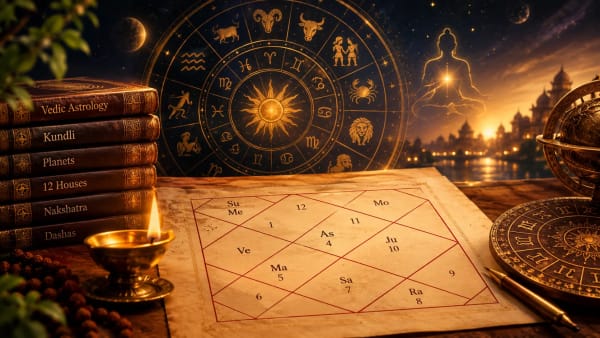
In Vedic astrology, the 7th house of your birth chart governs marriage, partnerships, and committed relationships. Astrologers look at three things here: which planet rules your 7th house, which planets sit inside it, and whether any of those planets are under stress from difficult aspects.
A strong, well-placed 7th house lord generally points to a smoother, more clearly timed marriage period. A weak or heavily afflicted one doesn't mean marriage won't happen it usually just means the timing is delayed or arrives through less conventional circumstances.
Then Comes the Dasha System
This is where Vedic astrology really separates itself from other traditions. Your life is divided into planetary periods called dasha with Vimshottari Dasha being the most widely used system. Each dasha and sub-period (called an antardasha) is ruled by a specific planet, and marriage is most likely to occur when the dasha lord connects, by rulership or placement, to your 7th house.
So instead of asking "what age will I get married," a Vedic astrologer is really asking: "when does your dasha timeline activate your 7th house?" That's a very different and far more chart-specific question than sun-sign astrology can answer.
Manglik Dosha: The Most Misunderstood Factor
If you've spent any time researching Indian marriage astrology, you've likely come across Manglik Dosha a placement where Mars sits in certain houses (1st, 4th, 7th, 8th, or 12th) of the birth chart. It's often treated as a red flag in match-making conversations, but the reality is more nuanced.
Manglik Dosha doesn't block marriage. What it typically indicates is a need for extra compatibility care which is exactly why traditional kundli matching places heavy weight on it. Two Manglik charts paired together, for example, are often considered to neutralize the effect entirely. It's a factor to be aware of, not a verdict to fear.
Why Kundli Matching Matters for Timing, Not Just Compatibility
Most people think of kundli matching purely as a compatibility check between two people. But it also plays an indirect role in timing because a well-matched pairing tends to move through engagement and marriage more smoothly once both parties' dasha periods align favorably. This is part of why families in India have historically waited for "the right time" rather than rushing a match, even when compatibility scores were high.
Jupiter and Venus: The Traditional Marriage Significators
Two planets carry special weight in marriage timing:
- Jupiter- the primary marriage significator for women's charts in classical Vedic astrology
- Venus- the primary marriage significator for men's charts
When either planet is transiting favorably, or when their dasha periods are active, astrologers pay close attention these windows are often when proposals, engagements, or weddings tend to cluster.
Can an AI Astrologer Actually Calculate This?
Marriage timing has traditionally required years of study to interpret correctly, since it depends on cross-referencing house placements, dasha periods, and transits simultaneously. This is exactly the kind of layered calculation where an AI astrologer adds real value processing your birth chart, current dasha, and planetary transits together in seconds, rather than requiring a manual, multi-step reading.
That said, even the most advanced AI reading works from the same classical principles described above it isn't inventing a new method, just applying the traditional one faster and more consistently.
The Honest Answer
There's no universal age or single date where marriage becomes "due." What Vedic astrology offers instead is a window of likelihood built from your 7th house strength, your current and upcoming dasha periods, and supporting transits from Jupiter and Venus. For a precise reading, you'll need your exact birth date, time, and location, the same details required for any accurate vedic astrology chart calculation.
If you're genuinely curious about your own timeline, that's the place to start not with your zodiac sign, but with your full chart.