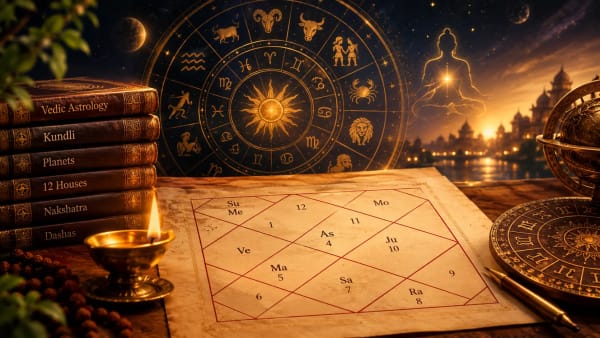
The 7th house is one of the most relationship-focused areas of a Vedic birth chart. In simple terms, seventh house astrology is the study of marriage, committed partnerships, contracts, and the way you relate to an 'other' in one-to-one relationships. Beginners often call it the marriage house, but the 7th house carries a broader meaning: it shows what you seek in a partner, how you negotiate, and how you balance your own needs with someone else's.
What Is the 7th House in Vedic Astrology?
In a Kundli, the 1st house begins at the Lagna, or Ascendant, which is the sign rising on the eastern horizon at the moment of birth. The 7th house is the seventh sign counted from that Lagna, so it sits directly opposite the 1st house. In Western astrology, this point is called the Descendant. In Sanskrit, the 7th house is known as Kalatra Bhava, meaning the house of spouse or partner.
The 7th house therefore represents the 'other' in your life. The 1st house is about your identity, body, and self-expression; the 7th house is about the relationships you form when you bring that identity into partnership with someone else. It is not a planet or a sign by itself. It becomes meaningful when you know which sign is on its cusp, which planets occupy it, and where its lord is placed in the chart.
For a complete map of the 12 houses, see this guide to the 12 houses in astrology.
| Aspect | Detail |
|---|---|
| Sanskrit name | Kalatra Bhava |
| Position | Seventh sign from the Lagna |
| Opposite house | First house (Ascendant) |
| Natural sign | Libra |
| Natural ruler | Venus (Shukra) |
| Key domains | Marriage, partnership, contracts, negotiation |
Seventh House Astrology: Key Areas of Life
Marriage and Committed Partnership
The 7th house is the primary house of marriage in Vedic astrology. It can indicate the kind of partner you are attracted to, the quality of mutual support, and the way you handle commitment. Venus is the natural karaka, or significator, of marriage, while Jupiter is also considered as a karaka for the spouse in many traditions. No placement alone decides whether you will marry or stay married; the 7th lord, the Dasha, and the rest of the chart all participate in the reading.
Business and Professional Partnership
The 7th house also governs formal alliances in professional life. Business partners, co-founders, joint ventures, and important contracts are classic 7th house matters. If you are analysing career changes, the 10th house shows the profession itself, but the 7th house shows the working relationships that support or challenge that career. A courteous, flexible 7th house expression is often seen as helpful for negotiation, while a difficult expression may ask you to learn boundaries and fairness.
Public Life, Negotiation and Open Competition
In traditional Jyotish, the 7th house also represents open enemies, public opponents, and legal disputes. The 6th house deals with hidden obstacles and daily service; the 7th house deals with matters that come out in the open and must be settled between two sides. This gives the 7th house a role in diplomacy, mediation, and any situation where you need to understand the other person's point of view.
The 7th House and the 1st House Axis
The 7th house is best understood as the mirror of the 1st house. If the 1st house is 'I am,' the 7th house is 'I relate.' In relationships, we often attract people who carry qualities we have not yet developed in ourselves. A person with a very strong Aries Ascendant may meet partnership lessons through a Libra 7th house: learning compromise, fairness, and patience. Another person with a strong 7th house may need to develop a clear sense of self before they can meet a partner as an equal.
This axis also shows that relationships are not just events that happen to you. They are interactions between your self-image and another person's. Vedic astrology uses the 7th house to describe that interaction, not to replace personal responsibility.
Planets in the 7th House and the 7th Lord
Any planet placed in the 7th house adds a distinct colour to partnership themes. For example, Venus in the 7th house is traditionally associated with charm, affection, and a visible wish for partnership. Saturn in the 7th house is often linked to a serious, cautious, or later approach to marriage, but it can also indicate loyalty and stability when the rest of the chart supports it. Jupiter in the 7th house is traditionally read as a positive influence on marriage, often suggesting generosity and ethical behaviour in partnership. These are traditional interpretations, not fixed promises.
The 7th lord is the ruler of the sign on your 7th house cusp. Its placement in the chart shows where partnership matters are activated. For instance, if the 7th lord is placed in the 10th house, marriage or business partnership may be connected with career and public position. If the 7th lord is placed in the 4th house, partnership themes may be rooted in home and emotional security. Again, this is only one layer of interpretation.
In Vedic astrology, timing is usually read through Dasha periods, particularly the Mahadasha and Antardasha of the planets, and transits. When the Dasha of the 7th lord or Venus is active, relationship matters may come into focus. But a Dasha by itself does not guarantee marriage, breakup, or any event. It helps you understand what kind of inner and outer climate you are passing through.
How to Read the 7th House in Your Kundli
If you want to explore your own 7th house, follow this simple sequence:
- Confirm your Lagna. The Ascendant is the foundation of the Kundli. Use your accurate birth time, date, and place.
- Identify the 7th house sign. Count seven signs from your Lagna, or look for the 7th house in your north or south Indian chart style.
- Find the 7th lord. The planet ruling that sign is called the 7th lord, and its placement gives another layer of meaning.
- Check planets in the 7th house. Even one planet can change the expression significantly.
- Look at the whole chart. The 7th house works with the 1st house, the 2nd house of family, the 5th house of romance, and the Dasha sequence. No single house is a complete story.
For a step-by-step method, see How to Read Your Kundli: A Beginner's Guide.
The 7th House in Marriage Astrology
When people ask about marriage, the 7th house is usually the first place an astrologer looks. But marriage astrology is not a single-factor judgement. Vedic astrology considers the strength of the 7th house, the dignity of the 7th lord, the condition of Venus, the Dasha periods, and the overall balance of the chart. One difficult aspect can be softened by a strong yogakaraka or a beneficial Dasha; a beautiful 7th house still requires real-life communication and commitment.
If you want to understand timing, read When Will I Get Married? What Vedic Astrology Actually Looks At. And if you have heard about Mangal Dosha, it may be useful to know that it is only one factor, not a curse: What Is Mangal Dosha? Meaning, Effects and Marriage.
Conclusion
The 7th house is the house of the 'other' in your life. It is one of the most important houses in Vedic astrology, because it describes marriage, committed partnership, negotiation, and the mirror between your self and someone else. It is not a fixed destiny or a promise. A chart that shows challenges in the 7th house can still express those lessons with maturity, and a promising chart still depends on the choices you make.
To see your 7th house sign and its lord, use your exact birth details to generate your Kundli with a tool such as YogiAI.live. Seventh house astrology is best used as a mirror for self-awareness, not as a substitute for action.
Frequently asked questions
What does the 7th house represent in astrology?
The 7th house represents committed one-to-one relationships, especially marriage and business partnerships. In Vedic astrology it is called Kalatra Bhava, the house of spouse or partner. It also reflects how you relate to the 'other' in close relationships.
Does the 7th house affect marriage?
Yes, the 7th house is one of the main houses used in marriage astrology. In Vedic astrology, analysts also consider the 7th lord, Venus, Dasha periods, and the overall chart before any conclusion. No single house placement guarantees marriage or predicts an unavoidable outcome.
How do I find my 7th house?
Find the sign on your Lagna, or Ascendant, in your Kundli; the 7th house is directly opposite it. For example, if your Lagna is Aries, your 7th house is in Libra. Accurate birth time, date, and place are needed to calculate the Lagna correctly.
What if my 7th house is empty?
An empty 7th house is common and not a flaw. Astrologers look at the 7th lord, planetary aspects, Dasha periods, and other houses to understand partnership themes. No planets in a house simply means that house expresses itself through its lord and the rest of the chart.
Is the 7th house only about marriage?
No. The 7th house also covers business partnerships, contracts, public negotiation, and open competition. It is traditionally known as the house of the 'other' in any one-to-one relationship.
What is the Sanskrit name of the 7th house?
The 7th house is commonly called Kalatra Bhava, which translates as the house of spouse or partner. In Vedic astrology, this name highlights that the house is about union, commitment, and the 'other' in our lives.