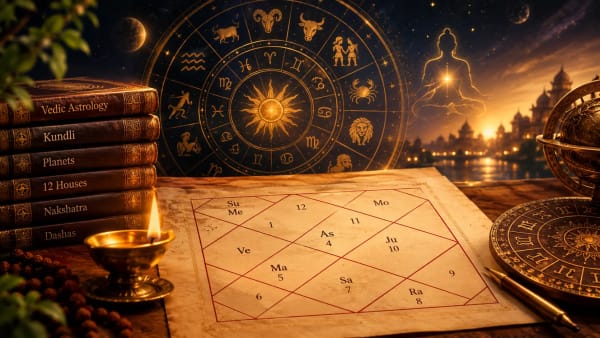
If you are new to Vedic astrology, the 12 houses in astrology can feel like a map with no legend. In simplest terms, the houses are twelve divisions of the sky at the moment of your birth, each governing a slice of life—personality, wealth, family, career, and much more. Think of them as the stage on which the planets (grahas) perform. In this guide, you will learn what each house represents, how they relate to your Kundli, and how to read them without getting lost in jargon.
What Are the 12 Houses in Astrology?
In Vedic astrology, a Kundli (birth chart) is a snapshot of the heavens taken at your exact birth time and place. The 360-degree zodiac is divided into twelve equal sectors known as houses, or bhavas. Each house corresponds to a sign (rashi) and a set of life themes. The first house is called Lagna or the Ascendant—it sets the entire chart’s starting point. From there, houses are counted counterclockwise around the chart.
Unlike Western astrology, which often uses the tropical zodiac, Vedic astrology primarily uses the sidereal zodiac, aligned to fixed stars. This means your Sun sign in Vedic astrology might differ from your Western sign. What remains constant is the house structure, which reveals how the planetary energies in your chart manifest in daily life.
The 12 Houses at a Glance
Below is a simple breakdown of the twelve houses in astrology, their Sanskrit names, and the life areas they govern. Keep in mind that these are broad themes; their full meaning depends on the planets that occupy them and the signs on their cusps.
| House | Sanskrit Name | Life Area |
|---|---|---|
| 1st House | Lagna Bhava | Self, physical body, personality, appearance |
| 2nd House | Dhana Bhava | Wealth, family, speech, possessions |
| 3rd House | Sahaja Bhava | Courage, siblings, communication, short journeys |
| 4th House | Sukha Bhava | Home, mother, emotional happiness, land and property |
| 5th House | Putra Bhava | Creativity, intelligence, romance, children, past-life merit |
| 6th House | Ari Bhava | Enemies, illness, debt, daily routine, service |
| 7th House | Kalatra Bhava | Marriage, partnerships, the other person in relationships |
| 8th House | Ayur Bhava | Transformation, inheritance, longevity, secrets |
| 9th House | Dharma Bhava | Fortune, higher learning, spirituality, destiny |
| 10th House | Karma Bhava | Career, reputation, actions, public image |
| 11th House | Labha Bhava | Gains, income, networks, hopes and wishes |
| 12th House | Moksha Bhava | Loss, expenses, foreign lands, spiritual liberation |
This table is a helpful cheat sheet, but remember: the houses are connected, and the story of your chart unfolds through all of them together.
How the 12 Houses in Astrology Work
In a Kundli, each house is ruled by a zodiac sign and a planet. Your Lagna (1st house) is the sign that was rising on the eastern horizon at birth. From the placement of your Lagna, the other houses are determined. For example, if you have Aries in your 1st house, then Taurus is your 2nd, Gemini your 3rd, and so on around the zodiac.
The planets placed in each house "light up" the topics of that house. A strong, well-placed planet in a house can bring positive results related to that house’s domain. A weak or afflicted planet may create challenges. But no single placement is destiny—it’s the combination of the planetary lord, the house position, and the Dasha (time periods) that gives the full picture.
The Quadrant and Trine Houses
Astrologers often group the 12 houses in astrology into special categories:
- Kendra (Quadrants): 1st, 4th, 7th, and 10th houses. These are the pillars of the chart and signify a person’s core life themes—self, home, relationships, and career.
- Trikona (Trines): 1st, 5th, and 9th houses. These are the most auspicious, representing dharma, prosperity, and good fortune.
- Dusthana (Challenging houses): 6th, 8th, and 12th houses. These are inherently difficult areas, but they also offer the most spiritual growth.
Understanding these groupings helps you see why your 10th house is so important for career, or why your 7th house relates to marriage.
Detailed Meaning of Each House
Let’s walk through each house and its role in your life with practical examples.
1st House: The Self
Your Lagna or 1st house defines your physical body, basic temperament, and how you project yourself to the world. It’s your natural start—your first reaction to new experiences. A strong 1st house often indicates good vitality and confidence.
2nd House: Wealth and Family
This house governs accumulated wealth, movable assets, speech, and the family you are born into. It shows how you value money and the words you use. For instance, an affliction here might indicate speech struggles, while a strong Jupiter can bring eloquence and financial stability—though nothing is guaranteed in isolation.
3rd House: Courage and Communication
Courage, younger siblings, short trips, and all forms of communication fall under the 3rd house. It’s also the house of your inner drive and self-effort. People with a strong 3rd house are often quick-witted and action-oriented.
4th House: Home and Happiness
Your home environment, mother, property, and inner emotional peace are ruled by the 4th house. It’s your foundation, both physically and emotionally. A well-placed Moon here often indicates a peaceful mind.
5th House: Creativity and Romance
This is the house of intelligence, creativity, romance, and children. In Vedic tradition, it’s also the house of Purva Punya (past-life good deeds). A strong 5th house can boost your creative expression and educational success.
6th House: Service and Challenges
The 6th house deals with daily routines, service, debt, illness, and enemies. It’s a house of obstacles that also builds resilience. Approaching its difficulties with service and healthy habits can transform its energy.
7th House: Partnerships and Marriage
This is the house of marriage, business partnerships, and any “one-to-one” relationship. It also indicates the nature of your spouse. For deeper insight into marriage timing, planets and Dasha periods matter as much as the house itself—see my article on When Will I Get Married: What Vedic Astrology Actually Looks At for a full perspective.
8th House: Transformation and Mystery
The 8th house is deep, mysterious, and transformative. It rules longevity, inherited wealth, secrets, and research. It’s often feared, but it’s the house of rebirth—where you shed old skin and grow spiritually.
9th House: Fortune and Dharma
This house is your luck, higher learning, spiritual path, and long-distance travels. It represents your relationship with divine law and your guru. A strong 9th house supports optimism and righteous living.
10th House: Career and Public Life
Your career, professional achievements, and public reputation are governed by the 10th house. It’s the highest point in your chart, symbolizing your contribution to society. For a deep dive into career predictions, my post on Career Astrology: What Your 10th House Reveals About Job Changes is a natural next step.
11th House: Gains and Networks
The 11th house is where you receive the fruits of your actions—income, gains, and fulfillment of desires. It also rules large networks, friendships, and social circles. Strong planets here can indicate financial inflows.
12th House: Liberation and Endings
The 12th house is the house of endings, loss, expenses, foreign lands, and finally, Moksha (spiritual liberation). It’s your subconscious and your ability to let go. It’s not negative per se; it invites surrender and inner growth.
How to Interpret Your Kundli Houses
To read the 12 houses in astrology correctly, you need more than just the house placements. Here’s a simple process:
- Know your Lagna: Your birth time is essential to set the 1st house accurately. A few minutes' difference can shift the Lagna. Use a reliable Kundli calculator with exact birth details.
- Check house lord positions: Look at the sign that rules each house (e.g., Taurus rules your 2nd if Aries is Lagna). Then find where that planet sits in your chart—its house placement reveals how that house’s matters play out.
- Note the planets in each house: A planet in a house “goes to work” there. For instance, Venus in the 7th house often indicates a loving spouse, but its condition matters.
- Apply Dasha (planetary periods): Timing in Vedic astrology comes from the Dasha system. Even a healthy house theme can be dormant until the right Dasha activates it.
No single house tells the whole story. For a step-by-step method of reading your full chart, consider my beginner guide on How to Read Your Kundli: A Beginner's Guide.
Common Misconceptions About the 12 Houses
- “A good 7th house guarantees a perfect marriage.” Not true. It matters, but so do the 2nd house (family), the 5th house (romance), and the current Dasha.
- “The 12th house is always bad.” It can bring loss, but it also symbolizes spiritual growth and foreign connections—for some, a blessing.
- “Each house has only one meaning.” Houses have many layers; the sign, planets, and aspects all add nuance.
Why Houses Matter in Vedic Astrology
The 12 houses in astrology are the backbone of your Kundli. They show the “where” of your life—where your energy flows, where you’ll shine, and where you might need effort. When you combine houses with the signs and planets, you get a rich, detailed map of your dharma (life purpose) and karma.
As you explore your chart, keep a healthy curiosity but also a grounded perspective. Astrology is a guidance system, not a hard science. It invites reflection, but it does not override your free will or dictate your choices. If you’re going through a complex phase, consider a professional astrologer’s reading instead of relying on snippets of information.
Conclusion
The 12 houses in astrology are a powerful framework that helps you understand the many dimensions of your life. From your identity (1st house) to your career (10th house) and your spiritual liberation (12th house), each house tells a story. Start by learning your Lagna, then explore the themes of each house, and finally bring in the planets and their periods. Over time, you’ll see patterns that illuminate your personality, relationships, and purpose.
If you want to go deeper into your personal chart, I encourage you to generate your free Kundli here at YogiAI.live and use this guide as your starting point. The stars are not your fate—they’re your map.
Frequently asked questions
What are the 12 houses in astrology?
The 12 houses are twelve divisions of the zodiac in a birth chart, each representing a different life area such as self, wealth, family, career, and spirituality. In Vedic astrology, they are called bhavas and are measured from the rising sign, or Lagna.
How do I find my houses in my Kundli?
You need your exact birth date, time, and place to calculate your Kundli. A Vedic astrology software or a professional astrologer can generate your chart, which shows the signs on each house cusp. Online tools like YogiAI.live can provide a free Kundli with house placements.
Which house is most important in a Kundli?
The 1st house (Lagna) is considered the most important because it sets the entire chart and represents your self and life direction. The 10th house (career), 7th house (marriage), and 9th house (fortune) are also highly significant for major life outcomes.
What does the 10th house indicate in astrology?
The 10th house indicates your professional career, public reputation, and social standing. It shows the field of work, your achievements, and how you are perceived in the world. Planets and signs here give clues to your professional path, but the actual job depends on many chart factors.
What is the meaning of a saturn in the 7th house?
When Saturn occupies the 7th house, it often suggests a serious, mature, or delayed marriage, or a partner who is older or responsible. In Vedic astrology, this placement can also indicate lessons in commitment. The effect varies based on Saturn's condition and sign.
Can the houses predict when I will get married?
Yes, the 7th house and its lord, combined with Dasha periods, are examined for marriage timing. However, Vedic astrology does not guarantee exact dates. To understand the factors better, read my article on When Will I Get Married? What Vedic Astrology Actually Looks At.