Karwa Chauth 2026 will be observed on Thursday, 29 October 2026. On this day, married women — and in many families, unmarried women and men too — keep a sunrise-to-moonrise fast and pray for the health, long life and wellbeing of their spouse or future partner. The tithi for the day is Krishna Chaturthi of Ashwin (amanta) / Kartik (purnimanta), as per the Indian holiday calendar. In this guide, you’ll learn the story behind the festival, its spiritual and astrological meaning in Vedic tradition, how it is observed across regions, and a simple ritual structure you can adapt to your own family’s customs.
When is Karwa Chauth in 2026?
Karwa Chauth falls on the fourth day of the waning moon, called Krishna Chaturthi, in the Hindu month of Kartik. In the amanta calendar used in many parts of India, the same lunar day is counted in the month of Ashwin. Either way, the Indian holiday calendar lists Karwa Chauth 2026 on Thursday, 29 October 2026.
Because Hindu dates are calculated from the position of the Sun and Moon, the tithi and moonrise are different for every city. The date above follows the Indian holiday calendar, and the tithi is computed for New Delhi. If you live in another city, check a Panchang for the exact tithi and moonrise in your location before planning the day.
| Detail | Karwa Chauth 2026 |
|---|---|
| Date | Thursday, 29 October 2026 |
| Tithi | Krishna Chaturthi |
| Paksha | Krishna Paksha (waning moon) |
| Month | Kartik (purnimanta) / Ashwin (amanta) |
| Primary deities | Shiva, Parvati, Ganesha, Kartikeya and the Moon |
The story and mythology behind Karwa Chauth
Karwa Chauth has no single origin story. Like many Indian festivals, it is a weaving of regional legends, each emphasizing a different shade of devotion. The story you hear often depends on the family you are sitting with, and that is part of its beauty.
Queen Veeravati
The story most often told in North India is that of Veeravati. She was the only married sister among seven brothers and returned to her parents’ home for Karwa Chauth. After fasting all day, she waited for the moon to appear. Her brothers could not bear to see her hungry, so they hung a mirror behind a pipal tree and made it look like the moon had risen. Trusting them, Veeravati broke her fast. The same night she received news that her husband had become gravely ill. Distraught, she sought help and was told that her fast had been broken too early. She observed the fast again with complete devotion, and her husband recovered. The story is less about magic than about intention: a fast kept carelessly is only a hunger strike; a fast kept with love becomes a prayer.
The story of Karva
Another popular legend explains the festival’s name. A devoted woman named Karva was bathing in a river with her husband when a crocodile caught him. Instead of losing hope, Karva tied the crocodile with cotton thread and asked Yama, the god of dharma and death, to punish the creature. Impressed by her courage, Yama granted her a boon, and her husband’s life was spared. In this version, Karwa Chauth celebrates the presence of mind and determination of a wife, not passive endurance.
Shiva and Parvati
In many tellings, Parvati asks Shiva how a woman can protect her family. Shiva replies that the fast of Karwa Chauth, kept on Krishna Chaturthi of Kartik, brings strength to a household. For this reason, images of Shiva and Parvati, along with Ganesha and Kartikeya, are central to the puja. Goddess Parvati is seen as the model of a loving and balanced partner.
Spiritual and astrological significance in Vedic tradition
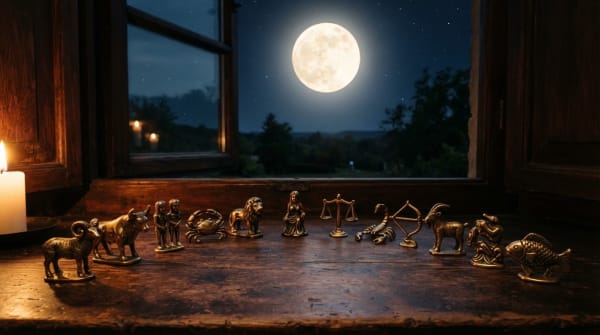
From a Jyotish perspective, Karwa Chauth is tied to the Moon and to the tithi of Krishna Chaturthi. The Moon is the karaka (significator) of the mind, emotional wellbeing and the mother. In Vedic astrology, a calm and well-supported Moon is associated with contentment, while a disturbed Moon is linked with emotional turbulence. Karwa Chauth falls in the waning phase, a time traditionally suited to introspection, purification and resolution.
At moonrise, women offer arghya, water poured through a sieve or fingers, to the Moon. Symbolically, the Moon’s reappearance restores clarity after a day of self-restraint. In the same way, a relationship is renewed by taking a pause from routine and placing attention on gratitude.
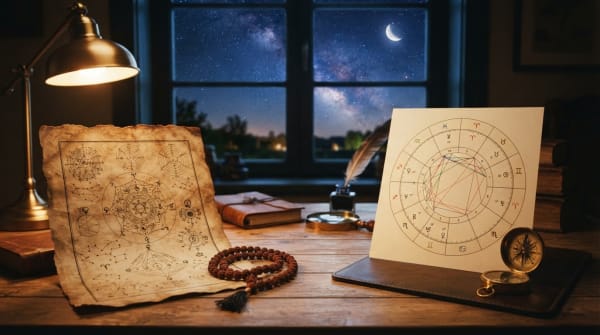
Astrologers would never judge marriage from one festival or one placement. A full birth chart, with accurate birth date, time and place, is needed, and even then astrology is an interpretive lens, not a scientific guarantee. If you are new to this, you can read what the 7th house means in astrology and how Vedic astrologers approach marriage to understand the bigger picture.
The festival also belongs to the autumn Kartik season, a time when families in many parts of India turn inward after the busy monsoon months. The cool, clear nights give the moonrise a gentle, intimate quality that suits the day’s mood.
How Karwa Chauth is observed across regions
Karwa Chauth is most widely celebrated in North India, but it has grown into a pan-Indian and diaspora festival. Customs vary from house to house and region to region.
North India
In Punjabi, Haryanvi and Uttar Pradesh homes, the fast usually begins after a pre-dawn meal called sargi, sent by the mother-in-law. Women wear their richest clothes, often red, pink or maroon, and apply mehndi. During the day they gather with friends, sing folk songs and prepare the puja thali. In the evening, older women narrate the katha while everyone listens with a karwa pot in front of them.
Rajasthan, Madhya Pradesh and other regions
Similar traditions are followed in Rajasthan and Madhya Pradesh, with regional songs and local puja items. In some communities, women keep a photo of Gauri-Shankar, an image of Shiva and Parvati, with a karwa pot filled with water, coins and sweets. Some families also fast for their children or observe a simpler pre-dawn meal.
Urban and diaspora adaptations
In cities, Karwa Chauth has become a social festival as much as a religious one. Unmarried women fast for a life partner, and some men fast beside their wives as a gesture of equality. Many people who cannot fast for health reasons join the puja, listen to the katha and pray with the family. There is no single rule; the essential part is the spirit of care.
A simple Karwa Chauth puja vidhi for beginners
This is a general guide, not a fixed rule. Please follow the custom used in your family and ask an elder if you are unsure. The times of the puja and moonrise depend on your city, so consult a Panchang.
- Set an intention (sankalp) before sunrise. A short phrase can be enough: “I keep this fast for the wellbeing of my partner, my family, or my own growth.”
- Take your pre-dawn meal if that is your family tradition. Many people eat sargi or a light meal before sunrise.
- Dress with care and apply mehndi if you enjoy it. This is a festive day, not a melancholy one.
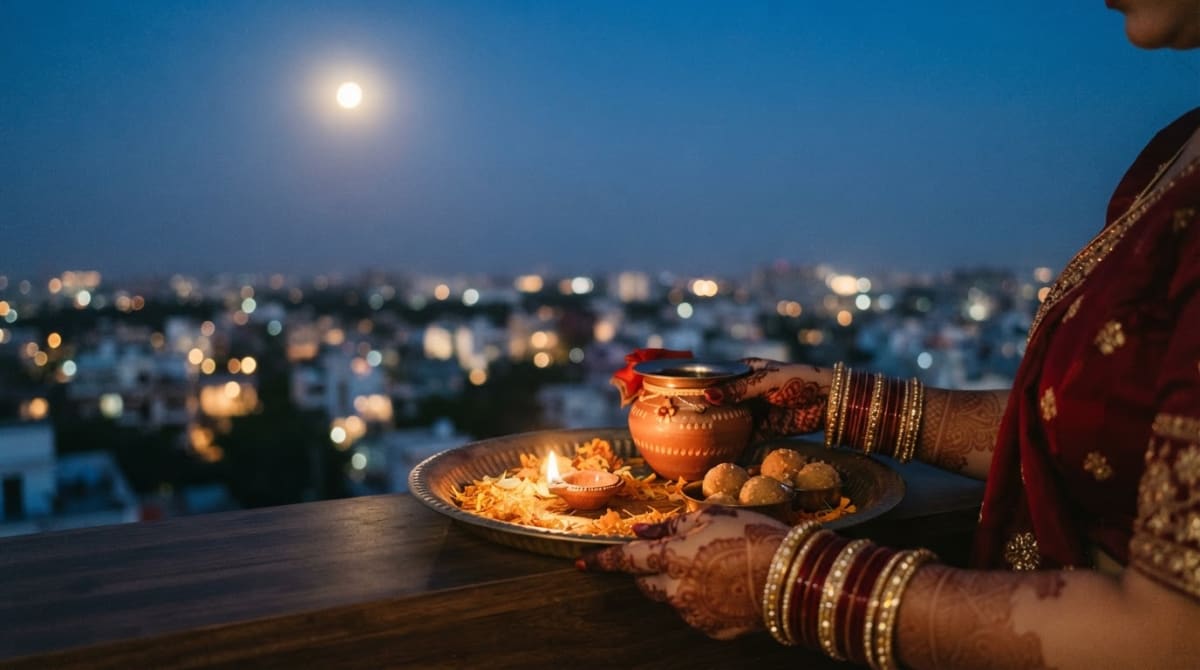
- Prepare the puja thali in the evening. Keep a clay karwa pot, water, milk, sweets, roli, rice, a sieve (chhalni), sindoor, incense, a diya and flowers. Add anything that represents abundance in your family.
- Gather for the katha after sunset. Sit together, face east or north, and listen to the story of the festival. If no storyteller is present, one person can read the story aloud.
- Perform the aarti. Moving the thali in a circle in front of the deities or puja image is traditional. Let everyone present offer a little water or flower.
- After moonrise, see the Moon through the chhalni or the spaces between your fingers. In many families, the wife turns to her husband and sees him in the same light, then offers arghya and breaks the fast with water or a simple meal.
If fasting could harm your health, do not fast. Pregnancy, illness, medication and old age are all valid reasons to eat normally or take a lighter fast. Ritual and astrology are never a reason to put your health at risk.
Moonrise timings and the local Panchang
One common mistake is using moonrise time from a national website or from another city. Because the moon rises differently at each longitude and latitude, Karwa Chauth moonrise can differ by 20 to 30 minutes even within the same state. This article deliberately does not give a single moonrise time or muhurat. Instead, check a local Panchang or a trusted Vedic calendar for your city on 29 October 2026. The tithi start and end times matter too, because they tell you when the vrat begins and ends. When in doubt, ask a local priest.
What to reflect on this Karwa Chauth
Beyond the ritual, Karwa Chauth is an opportunity to reflect on gratitude and partnership. The fast can be understood as a form of tapas (self-discipline) that sharpens attention, even if you cannot observe it fully. It also reminds us that relationships are sustained by small daily acts: patience, listening, kindness and presence.
Vedic astrology offers one language for thinking about these bonds. The seventh house and the Moon both appear in discussions about marriage and family, but no single placement tells the whole story. If you are curious about your own chart, begin with your exact birth date, time and place, and learn the basics with How to Read Your Kundli: A Beginner’s Guide.
Conclusion
Karwa Chauth 2026 on Thursday, 29 October gives you an opportunity to be with your community and to give care the attention it deserves. The exact details, like the moonrise time, the katha version and the puja items, may differ from one home to another, but the central thread remains the same: a day set apart for love, gratitude and togetherness. As the Moon rises, let it be a reminder that even after a long night, light returns.
Frequently asked questions
When is Karwa Chauth in 2026?
Karwa Chauth 2026 will be observed on Thursday, 29 October 2026. The tithi is Krishna Chaturthi in the month of Kartik (purnimanta) / Ashwin (amanta). Because timings differ by city, check a Panchang for your location.
Why do married women fast on Karwa Chauth?
Traditionally, married women fast from sunrise to moonrise and pray for the health, longevity and wellbeing of their spouse. In the festival’s mythology, devotion and fasting are linked to protection and harmony in marriage. Many unmarried women and men also observe the fast for a future partner or as a gesture of support.
What is the Karwa Chauth puja vidhi?
A typical puja includes preparing a thali with a karwa pot, water, milk, sweets, roli, rice, a sieve, diya and flowers; listening to the katha after sunset; offering arghya to the Moon; and breaking the fast after moonrise. Families often add their own customs. Always follow the ritual version used in your home.
What should I do if I cannot fast?
If fasting could affect your health, do not fast. You can still take part in the puja, hear the katha and offer your presence to family. Ritual fasting should never override medical or nutritional needs.
Do Karwa Chauth moonrise times differ by city?
Yes. Moonrise times differ with longitude, latitude and local geography, so they vary by city. Use a Panchang or a trusted Vedic calendar for your exact location on 29 October 2026.
Can unmarried women observe Karwa Chauth?
Yes. In many communities, unmarried women fast or join the puja for a suitable life partner, and men also participate in some families. Customs vary; the core is intention and respect.